← Children of Eden
CHAPTER 5 // LIOR
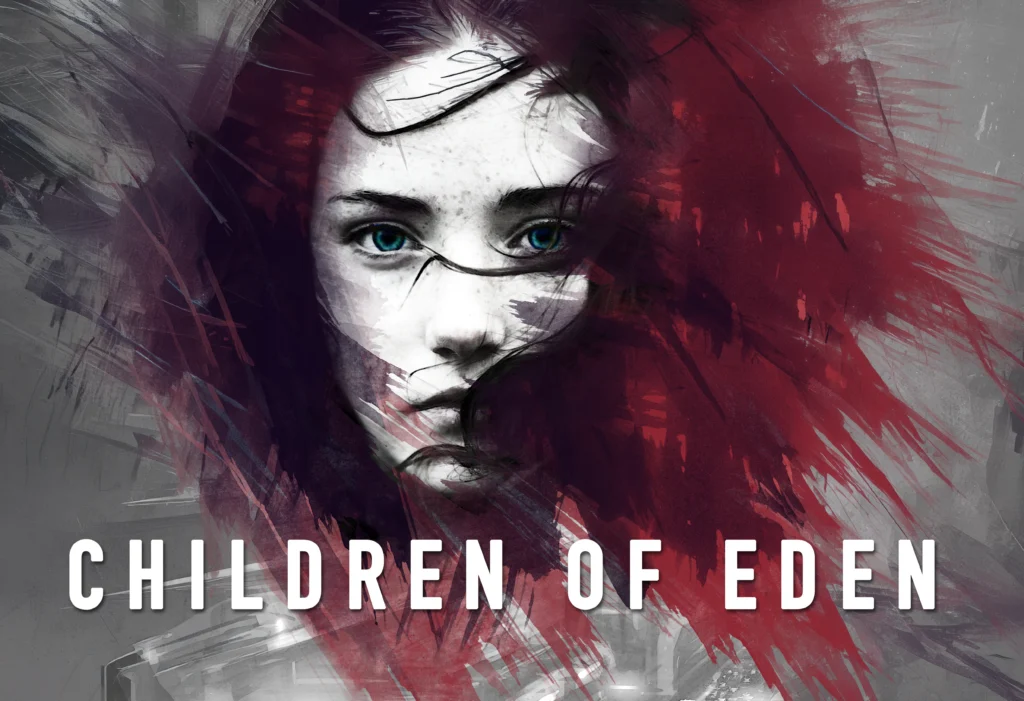
Lightning cracks the sky. For a moment, everything turns a sickly shade of purple. Daylight has broken, but outside the force field there is no semblance of a risen sun. A storm is brewing in the distance, making its slow journey toward the city. Sooner than later it will consume us, as all storms do. Enoch’s force field is a magnet for nature’s wrath. I count four heartbeats until there’s a slow rumble of thunder like the sound of a rolling boulder. It’s an omen of things to come.
I try to ignore the burning in my chest; my thoughts are as restless as the sky. I do what I can to put as much distance between us and Skaif’s Row. My legs churning like angry pistons, overworked and fatigued. Any moment, the tendons feel like they might snap and shred. I look back in bursts to make sure Coby is still with me, my gaze never goes beyond him. I can’t bring myself to see if we’re being pursued, I can only guess that we are.
“Lior,” Coby calls from behind me. He’s a good distance away, doing his best to keep up with my pace. “Lior…” He calls again, but I ignore him, driven by fear and urgency. We need to reach the causeway before the storm passes and the city comes alive. “Lior! Will you stop?!”
Coby’s voice stops me in my tracks, and I feel the blood coursing through my legs. They feel thick and heavy, triple the size and weight I know them to be. My body quakes, and I’m uncertain if it’s anxiety or adrenaline. Turning back to look at Coby, he, too, has stopped. He leans over, hands pressed to his knees, and gasps for air. I know the effort this is costing him, to move this quickly, but we don’t have the luxury of time.
“What is it? What’s the matter? Are you having an attack?” I pull the backpack off my shoulder, prepared to grab the supplies inside.
“No,” he says, panting. “I’m not…having an attack. Will you… You’re shaking!”
“It’s nothing,” I’m annoyed at his observation, finding it pointless and a waste of time. Yet no matter how much I try, I cannot stop myself from shaking.
“Something happened back there.”
“Coby…” I say, ready to tell him I’ll explain later. Another jet of lightning streaks overhead, turned electric violet from the force field. Thunder shakes the ground, and it feels as though there’s a restless behemoth sleeping beneath us.
“No, Lior. Tell me what happened.” He stands up, cheeks flushed, and looks me square in the eye. He’s angry with me in a way I’ve never seen. “Please… Just… I know you’re trying to protect me, but you can’t hide everything from me, either.”
Sometimes I forget how much of life Coby has seen. How much he already knows. He may be young, but he’s not the frail little boy I make him out to be. Part of me refuses to see him as more than that, hoping to preserve his innocence, but sooner or later it will diminish.
The image of the dead Corvant bubbles up in my mind, unwanted and uncalled for. I can still see the blood trailing from his nose; the way his eyes looked dim and vacant. Like a house when no one is home. And I remember the girl. The weeping, sorry mess of a girl. The way she looked at me, huddled in the corner with her clothes in tatters, unsure of what I am. Like she was torn between wonder and fear.
I’m not a monster, I wanted to tell her. But I couldn’t say the words because I haven’t yet convinced myself. No rational thought can explain what happened last night at Scylla’s. What I know is that had it not, neither of us might be here to wonder about it.
My legs grow weak, and I sink down to the curb before I fall. Coby follows, sitting beside me as I lose my gaze in the darkness of the pavement.
“He knew about you,” I say, my voice distant. “The was a Corvant at the brothel and he knew that you’re a…” My voice trails off, unwilling to say the word. “But I—I stopped him.”
“How?” I can sense Coby’s trepidation. He’s afraid to know the answer the same way I’m afraid to say it.
“He was choking me—trying to kill me. All I could think of was getting him off me, so I… I just pushed as hard as I could and then… I can’t explain what happened. Or how. I just know that…” I stare down at my hands, staring at them as though my palms might tell secrets. “It doesn’t matter,” I say, looking at Coby. Coming back to him. “What’s important is that you’re safe.”
His eyebrows knit together as he contemplates what I’ve said. Coby’s sharp. He understands. All I can ask is that he not think of me differently because of it. Tears sting the corners of my eyes, and I hate that they’re there—wiping them away with the backs of my sleeves before they have the chance to fall. It’s not the thought of this unknown ability that scares me, it’s that I’ve become something I never wanted to be: a murderer.
Coby puts his arm around me, and for the first time I feel small, delicate. Our roles reversed. He rests his head against my shoulder and I think of the mother and daughter I saw in the central promenade the day of the Archon’s announcement—the day this all began.
“As long as I’m with you, I know I’m safe,” he says, the words so simple and soft and earnest. They pull at the lynch pin barely holding me together. This time, the tears come hot and thick, pouring over my cheeks and I do not resist them. If only I could be everything Coby needs me to be.
I hold him close to me in the waning darkness listening to an angry sky. Safety. It’s becoming such an obsolete idea as nowhere seems safe anymore. But that can’t be true. I won’t let it. Somewhere, that safe place is waiting for us.
I want to linger in this moment, where it is just Coby and I and the world is quiet around us. The way it used to be. But I know the quiet is the precursor to a more severe storm than the one that rages overhead.
“Lior, look.” Coby says softly, and I lift my eyes from the ground to follow the path of his outstretched finger. Barely noticeable between the abutting walls of two buildings is a stairway, its path guided by bulbous, slow-blinking lights.
“The Causeway!” Unexpected joy washes over me, warm like fabled sunshine. I grab Coby and scoop him up, swinging him around as we both laugh—savoring the one bit of luck we’ve had. We are so close to the Fourth Precinct. I don’t know what awaits us there, but I’m hoping it will give us a bit of anonymity and time to chart our next course of action.
I set Coby back on his feet, our mirth short-lived. We stand in the resurrected night, eying the way ahead. From my best guess, we have about another three or four clicks before we reach its base. About two hour’s time if we start now.
“Can you make it?” I ask, looking back at Coby.
For the first time in recent memory, he’s smiling. I lean into him, kissing him on his temple, and help him to his feet. In the times I feel I can’t do this, Coby is the strength that drives me on. As we stand, I slip on our remaining backpack, place my arm across Coby’s shoulders, and together we continue on into the restless, diluted night.
What ground we have left to cover twists into a knot of streets and alleyways, many of them dead-ending into one another. Above, the generator presides over the sky, a towering shaft of midnight grey metal, mocking us with its proximity, but complexity to find. At the top-most point, a thick beam of fluorescent magenta arcs high along the precinct, and though it baths everything in red-purple light, it illuminates nothing.
Our footfalls echo around as Coby and I run down yet another familiar road. Our urgency and desperation has overrun the need for secrecy.
“We’ve been down this way,” Coby calls from several paces behind me.
“I know!” I snap at him in my frustration, coming to a sudden stop. Dehydration makes my breath ragged and wet, phlegmy with webs of thick saliva. My lips can’t recall the taste of water. Perhaps it’s only been days, but those days wear the guise of weeks. The rush of the current below is a cruel tease, tons of water flowing perpetually beneath our feet; the sound funneling up through grates in the street. Like the Causeway, it taunts me with its nearness and inaccessibility.
Coby draws up beside me, his neck and face bright red. Sweat drips down his face and dampens the collar of his shirt. “If we never have to run again, I’d be okay with that,” he says in between labored breaths. His comment makes me smile, a fleeting reprieve from the constant pressure.
“I think we’re done with running.” At least for now. I stare up at the seemingly indomitable wall. It must be six hundred feet high or more. The buildings in this part of the Furrow are too low to give me an accurate picture, rising one or two stories at the most. As I continue to survey the wall, my eyes graze across the column of lights I had seen before, the large bulbs blinking in lazy unison. To their right, I can just make out a narrow, zigzagging shape. I strain through the darkness to try and discern what it is. A streak of lightning cuts across the sky throwing light at the shadows, and that’s when I see it. Cresting over the tops of low-roofed buildings and jutting out from the surface—nearly camouflaged by the lusterless steel—is a pathway of stairs. It folds in on itself, doubling back to reach the full height of the wall. I don’t need myth or legend to tell me what it is.
“Come on!” I say, breaking into a run. I hear Coby groan, but when I look back, he’s close behind. Without any way to know where each road leads, we set out on the first we come across.
People emerge from their houses, and I understand what little it takes to make a home. They are buildings simply by architectural constitution, comprised of crumbling brick, battered sheets of metal, and ripped tarpaulin—anything to make four walls and a roof. If the Fifth Precinct is known as the slums of Enoch, this would be considered the gutter.
I wonder where everyone is headed, sensing that something is drawing them out. Their movement doesn’t seem as routine as it does forced. Mothers clutch at their children, holding them close by fistfuls of knitted fabric, worry and fear etched into the creases of their faces. I hear an infant cry, the sound funneling through and echoed by the slender alley. I spot a woman with a cocoon of fabric swaddled across her body. She rocks it consolingly, leaning in to whisper comforting words. For a moment she turns in our direction, her eyes wet with tears.
Behind us, a young man calls for his sister. She’s a feather of a thing, probably no more than sixty pounds soaking wet. All knees and elbows with a shock of frizzy brown hair that sprouts from the sides of her head. She’s dressed in what looks like a brown, woven sac, tattered sandals barely covering the bottoms of her tiny feet.
“Let’s go, Amara,” the older boy calls to her. She’s planted herself on a small stoop of stairs, clutching a dirty, matted doll. It’s a toy version of her, face smudged with soot and set in a helpless expression. The child named Amara slowly shakes her head. I understand her reluctance. If I had my choice, I, too, wouldn’t want to go, but our world offers little in the way of choices. At first I think they are refugees, hoping to flee the oppression of the Fifth just like Coby and I, that their sadness is a result of having to leave their homes behind. But I notice the distinct lack of belongings.
Radio static cuts through the air, heralding the Corvant who appears in the mouth of the alley like some militarized shadow. Beyond him, a stream of faces moves like a human current shuffling on slow, unwilling feet. I’m surprised to see how many there are. Well into the hundreds, all moving together and yet each independently, like reeds in the wind. Black helmets rise above the crowd—resilient through the steady moving traffic—ensuring everyone is moving in the same direction. Northeast. Toward ReGen.
“What do we do?” Coby asks from beside me. I hesitate for a moment, unsure of what to do. My heart races as fear and memories of Scylla’s Den cloud my brain, making it hard to think. The sound of white noise crackles behind us, snapping me back to the present.
“Is there a problem?” A Corvant appears behind us, speaking to Amara and her brother, both of whom are still standing outside their home.
“No, officer,” the boy says.
“Then get moving.”
“Yes, sir… Come on, Amara.”
“I don’t want to.” The child’s voice quavers.
“Amara, let’s go. Now.”
In an effort to avoid an altercation with the Corvant, I put my arm around Coby’s shoulders and guide him forward toward the crowd, falling in line behind Amara and her brother. I watch the way she holds onto him, voluntarily taking his hand. A thought crosses my mind, supplanting Coby and I in their position. What if Coby were healthy? Would he still feel hunted? Would we be this desperate to escape? I wonder how different our lives would be if it had been untouched by the virus. If things were…
In the quiet of my mind I reprimand myself, thankful that my thoughts are mine alone. I’m ashamed I even dared to consider it. That dirty, perverted word: normal.
We move reluctantly through the crowd, veering toward the perimeter when chance allows. At every break between buildings, I look for an opportunity to escape. But for every side street and narrow passage, there are armored vehicles and Corvants blocking the way. Anxiety wells up from my toes as I turn back to look at the lights along the generator wall beside the causeway, growing further and further away.
Some thirty feet in front of us a couple and their toddler have stopped amidst the throng, diverting people around them like a rock that parts a river. I can’t fully see what’s happening over the heads in front of me, but a Corvant soon steps in to interrupt. There’s a heated exchange between father and officer, their dialogue hard to hear. As the crowd continues to part around them and we draw closer, I see the wife doubled-over. Something ails her. It’s clear by the way she’s clutching her stomach, one hand still holding tightly onto her son’s.
“She just needs to rest!” I hear the husband say, his tone rising.
“Keep moving,” the Corvant commands, voice flat. His lips are all that move, peeking below the visor of his helmet. He levels his rifle with the man’s chest.
“For Eden’s sake! She just needs a minute!” The man’s face contorts with anger. I can feel the pace of the people around me slow as they crane their necks to watch what’s going on. Others turn a blind eye, content to not pull unwanted attention.
“Please, officer,” the woman says between broken breaths. It takes only a fraction of a second for me to recognize the symptoms. The subtle rings around her eyes, the sweat that beads along her forehead—she’s a Carrier. Her infection may only be in its early stages, but there’s no denying that she and Coby share that bond. “I just need a moment. That’s all,” she says, panting. “Just a moment and then… We’ll be moving.” Now at the brink of the action, I can see the tears brimming in her eyes.
The Corvant steps in toward the woman, grabbing her by the arm and drawing her up to her full height. “You move when I say you move,” he says, gloved hand gripping her above the elbow. The woman cries in pain from the Corvant’s grip just before he thrusts her in the direction of the shifting crowd. Unable to get her feet beneath her, the sudden force topples her to the ground. Caught amidst the action, their son—a child no older than three—begins to cry. His large brown eyes swell with terror, his innocent mind working to make sense of the unprovoked violence.
“Get your hands off her!” The husband yells, shoving the Corvant while his back is turned. The Corvant barely moves, as though his boots weight him to the earth. He pivots at the waist like a turret, gun taking aim. Three shots rip through the morning air, echoing off brick and stone. I watch as three spots on the man’s body erupt with red mist. Stomach, chest, throat. The bullet wounds weep with blood.
“Merick!” The woman screams from where she lay sprawled on the pavement, her son matching her pitch. Without hesitation the Corvant swivels back towards the wife. This time it is only a single shot, perfectly aimed right between the eyes, and it delivers swift and absolute silence. A ripple of screams rent the air, but as their voices subside, it is only the child’s lament that now fills the heavy air.
A matter of seconds was all it took for the boy to become just another orphan.
My first instinct is to turn Coby away, to shield him from the trauma, but the damage has already been done. Limbs and shoulders bump and crash against me as I feel the herd break into a frenzy. The sound of gunfire has terrified the flock. Is this what Krull meant when he said any resistance would be dealt with accordingly? Is this his idea of swift discipline? Discipline at least offers room for correction. This is just plain murder.
The Corvant responsible for killing the couple scoops the young boy up in one arm, passing him off to another who cuts through the frightened crowd as though wading through a current. More gunfire erupts farther down the line. An attempt at order has given way to pandemonium. People begin to rush past us, some of them running, bumping into us as they go.
Without a word, I grab Coby by the hand and begin to navigate through the chaos. I search for an opportunity to break from the crowd, hoping to steal back towards the causeway, but every intersection we come across we are blocked by Corvants. Behind us I hear assault rifles firing as there’s an attempt to control the situation. We’re halfway down the wide alley, amassed within the throng, when Coby’s hand is yanked free of mine. I cannot describe the feeling of fear it creates within me; the panic that comes from the smallest action.
Reeling on the spot, I turn back to find him rooted in the middle of the street, his boyish face frozen with a look of shock. His eyes grow wide and dark as if his spirit has momentarily stepped away.
“Coby!” I yell, trying to bring him back to me. As with the family of three, the crowd parts around us as they scurry frantically past, making for a narrow berth. “What is it? What’s the matter?”
I’m afraid that our luck has run out, that Coby’s strength has tapped itself dry. I anticipate him having another attack right here amidst the bedlam, exposing the truth of what he harbors within. But when I look into his eyes, they are not heavy with fever or fatigue. “Coby,” I say, trying to rouse him out of the trance he’s in. “Coby, listen to me. Now isn’t the time to stop!”
“He—He shot her.” He says, his voice so small that I have to strain against the din around us in order to hear. Life returns to his eyes, the darkness thawing into blue as tears blossom and spill down his cheeks. “He knew what she was and he shot her.”
Of course Coby knew the woman was a Carrier. He of all people would know. He probably recognized it before I did. I take his small hand in mind only to realize he’s cold and shaking. My heart withers within my chest. I want to pull him close and soothe his fears, but we haven’t the time and there’s only so much words can do.
“Coby,” I say, trying to get him to see reason though my gaze is more on the rush of people than on him. Sooner or later our stagnancy will draw unwanted attention. Giving as gentle a tug as I can, I attempt to pull him with me. “We have to go.”
He doesn’t yield, his body heavy with defeat.
“Why? What’s the point?”
Overhead, shots echo in our direction. The Corvants are coming.
“They’re going to kill me,” he says, his eyes purposely finding mine. “Once they know what I am.” I look around furiously, praying to Eden no one overhears what he’s saying. “I’m what they’re looking for, and they’re not looking for Carriers because they want to save us. You know it and I know it, Lior—If they catch me, I’m dead.”
“Listen to me,” I say, suddenly impassioned. My eyes lock onto his. “They’re not going to catch you. You are my brother… I will do whatever it takes to save you.”
The gunfire is getting louder. I break eye contact with Coby to see three Corvants bob above the crowd, visored helmets shielding their identity. Beneath them they are no one. As long as they wear those helmets and bear the mark, they are Krull’s nameless soldiers. He would know the best way to turn someone into a mindless weapon is to remove the parts that make them human. Fire bursts from the ends of their rifles with a rattling echo. Civilians disappear from the rush, falling out of sight with a sharp cry. I’m determined not to add either of us to the body count.
“Coby,” I say. His name sounds different, heavier on my tongue—as though I’ve never before felt its importance. “You have to trust me. Please. You have to trust that I am going to get us to safety.”
“But what about the causeway?”
“We’ll have to find another way. But I need you to trust me, okay? And right now we have to go.”
He wipes at his cheeks with the heels of his hands. “Okay.”
A small part of me softens with relief as he finds his resolve. I pull him into a hug, although briefly. My fingers entwine with his tousled brown hair.
Looking over Coby’s head, I see the Corvants advancing, no more than a half click away. I don’t need to take his hand anymore. Coby is not the naive little boy I think him to be. He may be frail at times—and even scared—but so am I. Like everyone, he has moments of strength and weakness, cowardice and bravery. Despite what I sometimes think of him, he’s no more a child than I am. If we’re to make it through this together, I’ve got to trust that he wants to live just as much as I need him to. Coby’s own determination will be his driving force. Not my selfishness.
We rejoin the current, blending into the flow of people, any opportunity to turn back in hope of accessing the causeway is lost. Instead, we’re marshaled through the street like prisoners sentenced to their death. A solid line of Corvants follows at the rear, their assault rifles aimed at our backs.
Ahead, in the distance, train trellises emerge from puffs of sewer steam to canopy the open streets, matching the height of the adjacent buildings. They materialize through the fog like sentinels composed of black, crisscrossing steel. Parked atop, diffusing the light of a newly dawned sun, is a long, bullet-headed train.
The crowd dams at the base of a narrow, black stairway that leads to the train station overhead. Corvants and citizens, packed tight as cattle, push and shove one another through the congestion. Even children and elders receive the same brutal treatment.
I direct Coby ahead of me, keeping my hands on his shoulders so as not to allow him to stray from my sight. Slowly, we ascend the stairs to the platform above. Ahead of us, a fight breaks out mid-step. A man, trying to get to a loved one, pushes another out of the way. It escalates from insults to fists in a blur of seconds, one of them falling backward through the crowd and causing a series of screams and shouts as people are hit unexpectedly.
Cresting the platform, the train spans out before us like an uncoiled, metal snake. Its sleek, silver body absorbs the red-orange glow from the force field above. Rows of windows along the middle turn the reflections of frightened civilians into ghosts. Black-suited Corvants stand at the entrance to each car, overseeing the loading of each passenger. As we slowly draw nearer, I recognize the blue double-helix logo emblazoned along the train’s exterior. So, this is their plan. They intend to deliver us to the precinct’s ReGen center by way of train.
Ahead of us, I recognize the same teenaged boy and his sister, Amara. I’m mildly surprised to see them, thinking we would have been separated during the moments of anarchy. Coby and I board shortly behind them, and I allow for him to go first.
My pulse jumps to a gallop as we pass between the two Corvants guarding the car door. I fear they’ll stop us, identifying Coby as a Carrier the way their fellow officer did, but we pass through like everyone else.
The car has started to fill with people, amassing into rows of distressed and tearful faces. No one speaks, not even in hushed tones, the collective sense of fear is palpable in the air. There’s an eeriness to the forced silence, the only sound is that of shoes passing along the metal floor and the struggle to keep tears at bay.
Walking along the center aisle, I glance at the people around us. Men and women cling to each other, heads on shoulders as children sob into laps. One man, seated alone, nervously toys with a VaPak between his fingers, staring vacantly at nothing. Krull told us these precautions were to ensure Enoch’s safety, but how safe is a city if its people do not feel protected?
A Corvant, his face fully concealed behind a black visored helmet, directs Coby and I to an empty seat toward the back of the train car. With my eyes on his rifle, I quietly comply, steering Coby by the shoulders. He shuffles in toward the window, settling himself to stare at his hands in his lap.
“You okay?” I ask, the question beyond the obvious.
Coby looks up and gives me a soft smile, the kind that bends the lips but never reaches the eyes. The kind you hope will relieve you of conversation.
Leaning forward, I kiss his forehead and take the opportunity to look out the window. The generator we once were headed toward is again beyond our reach, any sign of the causeway—the stairway, the slow-blinking lights—erased from sight. All that remains is the same, faded magenta glow.
The injustice of it burns within me. We were so close! We are still so close. If only we can find a way off this train, but our chances of that seem impossible. There are too many Corvants, more than I’ve seen in the entire Fifth Precinct. The odds of outrunning them all…
Commotion breaks out near the entrance. A Corvant has divided a family, directing father and son into a separate car while mother and daughter join ours, occupying the last few seats. The mother knows better than to protest, but the girl begins to wail, hands reaching for her father as he and the boy are ushered down the platform.
“Shhh, shhh,” the mother says, pressing her daughter to her. There’s a vibrato to her voice as she tries to suppress her own panic. “Come, child. It’s okay. These men are here to help.” I watch as she nervously glances up at the Corvant, uncertainty in her eyes. She knows there’s no truth to her words, but still she hopes—in the way only a mother can hope that things will be better for her child.
Beside me Coby elicits a cough. I turn sharply to see him burying his mouth into the crook of his arm. I look to see if anyone else has noticed, but the people around us are too occupied with what’s happening at the front of the train. The door hisses shut, sealing us inside. One of the Corvants who saw us onboard begins to make his way down the aisle, taking his time to scan each of the passengers.
“Coby,” I whisper, crouching in toward him. He doesn’t respond, doing his best to suppress another oncoming cough. “Coby. Look at me.” When he does, his face is splotchy and red and I know he’s straining against the start of a fit. Not now, I think. Please, not now.
Coby coughs again and my heart soars up into my throat. I suddenly remember the vial of Amaranthus, thrusting my hand into my pocket to make sure it’s still there. Sure enough, I feel the smooth, sleek curvature of the glass. If I can just give him a small injection…
Opening the backpack on my lap, I reach inside for the syringe, my fingers brushing against folded fabric. Short on patience, I pull open the neck of the bag and dump everything onto the seat between us. Clothes. Only clothes.
Stark realization throbs through my entire body.
I grabbed the wrong bag!
After what happened at Scylla’s, there was no time to think. The commotion from the fight had awoken everyone else. There were noises in the hall, the sound of doors opening. A scream. All thought immediately became instinct. I ran back to our room, roused Coby out of bed, and hurriedly gathered our things. In my haste, I only grabbed one of our bags before we fled through the window, using the roofs of the adjoining buildings to make our way down to the alley below. That must’ve been when I forgot the bag beside the bed. The bag full of Coby’s medical supplies.
Staring down at the tiny bottle of Amaranthus, I want to cry. It feels like a trick—a grand, cosmic joke. We have the thing we need, but not the thing to use it. I shoot a glance in the direction of the Corvant still moving through the seats.
Forcing myself to think, I try to come up with other ways I can give Coby the medicine. He could ingest it, but I don’t know if that will work. I’ve only ever seen people inject the drug directly into their bloodstream. For some unknown reason, Scylla comes to mind. I remember her casual indifference as she pressed the VaPak to her throat, pumping her lungs full of tar and carbon… The VaPak!
Beside me, Coby stifles another cough, burying his mouth as hard as he can into one of the shirts I’ve emptied from our bag. My gaze shoots upward, sifting through the backs of heads. The Corvant is drawing nearer, moving slowly but steadily. We may have avoided grabbing his attention, but across the way, I see a young man staring in our direction. The look on his face says it all. He knows. Our eye contact lingers for a heavy, prolonged moment. Fear and panic pull away, replaced by numbness, as I wait for him to expose us. But instead he nods, and I get the sense he understands. I watch as he rises from his seat and makes his way down the aisle, engaging the Corvant in conversation.
“Sit down.”
“What’s going on?” The man asks. “Why are you doing this?” Heads turn in their direction, caught off guard by the disrupted silence. But the man isn’t looking for answers. He’s buying me time.
Seizing the opportunity, I lurch forward along the seats to the man I had seen earlier. I tap him hard on the arm and he turns in quick alarm. I press my finger to my lips, signaling for him to remain quiet, shooting occasional glances down the aisle to see if the distraction is working. It is, wonderfully.
“I said sit down,” the Corvant commands.
“No. I think we deserve an explanation for why you’re treating us all like prisoners!” The demand causes a few others to voice their agreement.
Still engaged with the other man, I point to the VaPak clutched in his hands. The stranger looks at me questioningly, reluctantly offering the cylindrical device as if he’s unsure it’s what I’m asking for. Thank you, I mouth, grabbing it eagerly and retreating back to my seat.
I turn the VaPak around in my hands, trying to make sense of how the thing works. There’s a bulbous, glass tip at one end and a loading point at the other, where a cartridge is inserted. Bending down between the seats, I drive the glass tip down into the hard metal floor. It cracks easily, and I turn the device upside down over my palm. The slender, rounded interior slides free, and I see a small needle where the trigger punctures the cartridge of vaporized tar. I’m able to unscrew the needle, repositioning it within the brace so it faces outward. I slide the guts of the VaPak back into the case. It’s the closest thing I can make to a syringe.
Around me, I hear some of the other passengers lend their voices to the growing uproar. Unable to distract myself, I unscrew the top of the Amaranthus and tip the vial so I can access the yellow-red liquid. Thankfully, the modified VaPak works. It sucks up a portion of the drug, and I reach for Coby’s arm. Sweat and tears drip along his face. I close my eyes, say a quick prayer, and plunge the needle into the crease of his elbow.
I’ve just retracted the VaPak when there’s a loud sound. I look along the aisle to see the man who had been helping me knocked to the ground. The Corvant bends down over him, crashing the buttstock of his rifle into the man’s face. The bridge of his nose splits as blood spurts across the floor. His head collapses against the metal, the fight instantly beaten out of him, but not before he gets one last look in my direction.
“Shut up! All of you!” The Corvant yells, commanding immediate quiet. He takes a large step over my fallen ally—if he is anymore—and moves swiftly along the train car.
I hurriedly throw everything into the backpack—VaPak, clothes, vial—and stuff it under the seat. Wrapping an arm around Coby, I pull him toward me so that he’s resting against me. “Close your eyes,” I whisper to him, but my directive is unnecessary.
I turn my attention out the window, heart pounding furiously, as the Corvant finally makes his way down the aisle toward us. The officer looks down at us, and I ignore his presence, hoping to appear inconspicuous. Perhaps he’ll only think Coby is asleep. The officer hesitates for a moment as though unsure of us, and then continues past. My heart and the train give a lurch as the train begins to move.
I breathe a sigh of temporary relief.
There’s a crackle of radio static from the back of the train. “Commander, do you copy? This is Rancor,” I hear the Corvant speak into his comm system behind me. “I’ve got them. They’re on board.”
38
0
