It’s Martin Luther King Day here in the United States, and on this day we are encouraged to remember Dr. King and his message of racial inclusion. But more than remember, let us reflect on the Civil Rights movement and examine just how much progress has been made since his famed “I Have A Dream” speech, delivered more than 50 years ago. Spoiler alert: not that much.
There are still people alive who remember the days of segregation. And, if you think racism and white supremacy have been washed away in the past five decades, we need to have a chat. In fact, let me stop you right here and direct you to the most recent episode of our podcast. Therefore, it being Martin Luther King Day only serves to make this article both timely and ironic.
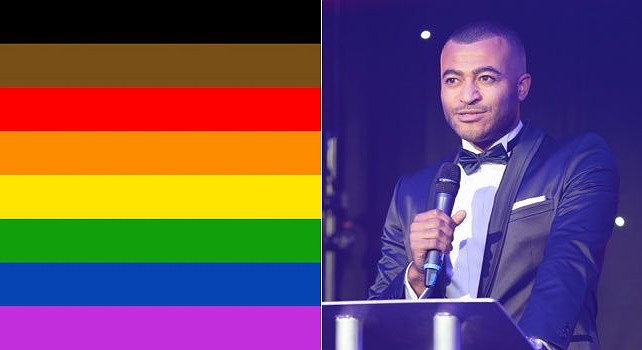
Just last week, Chief Executive of Manchester Pride, Mark Fletcher, announced that the organization will be adopting the expanded, eight-stripe version of the Pride flag to include a black and brown stripe in “in order to better recognise BAME (black, Asian and minority ethnic) LGBT+ people.” And just like one particular ad regarding shaving cream, people are in an uproar.
Immediately, the comments on Attitude magazine’s Facebook post begin to fill with the trite and repugnant rhetoric of, “Why are we bringing race into this? The flag was never meant to represent race. It’s a rainbow! It represents everyone.”
Here’s the thing, when Gilbert Baker designed the Pride flag at the behest of Harvey Milk in 1978, no, it was not constructed with race in mind. (Historically, when have White people done anything with race in mind, unless it was to oppress?) But it did have two additional stripes on it—pink and turquoise. Each of the original eight colors (pink, red, orange, yellow, green, turquoise, indigo, and violet) were chosen to represent universal themes within the Queer community (and arguably, the human experience), and therefore indicate more abstract ideas. But pink was retired because the fabric in that color was not easily accessible. And in 1979, the turquoise stripe was dropped because of the orientation of the flag as it was hung from lamp posts throughout San Francisco. (Turquoise fell in the middle, and was thereby obscured by the post itself.) So, within it’s first year of life, the Pride flag underwent two transformations.
Since then, the flag has gone through many incarnations. At one point, a black stripe was added to symbolize those who died from the HIV/AIDS epidemic, but was consequently removed. (Source) A star field, a pink triangle, a black triangle, and a white symbol of the Greek letter lambda have also been added at some point in time. Most of us will recognize the version with the star field as it is the American flag with the red & white stripes replaced by the six-striped version of the Pride flag. Shall we count this as ambiguation or bastardization even though some will be vehemently upset by the presumption of the Queer community? Obviously not. The reason we often fly this flag is to demonstrate that LGBTQ+ people are a part of this country as well—it is to call attention to our existence in a society that would otherwise seek to exclude us.
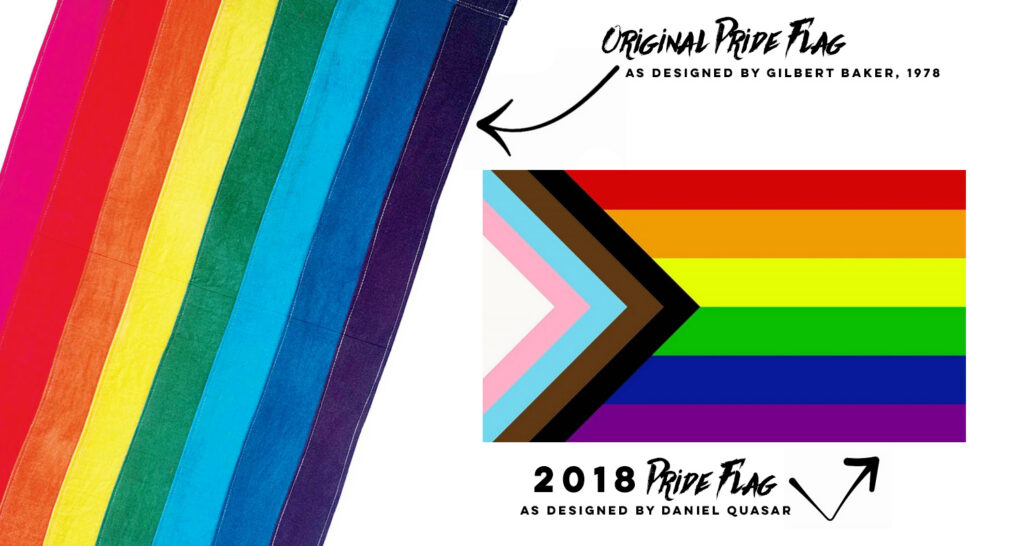
Fast forward to 2017 when the first version of the Philadelphia Pride flag was introduced. The comments that arose are the same aforementioned contempt—complaints about race showing up where it “has no right to be.” Or that the addition of such colors makes “the rainbow look ugly.” Say it again, but come closer so I can smack you.
Allow me to red-line something. The addition of the black and brown stripes serve the same purpose as the star field. It is drawing attention to something—that people of color are a part of this community as well, and that they have been historically excluded from the narrative. Argue with me that the rainbow represents everyone, but then turn toward your Queer brothers and sisters who are people of color and try saying the same. Additional comments I have seen on these public forums are, “Well, if this is about race, then what about Asian people?” These statements, again, coming from White men.
Well, ask them. Turn to your gay Asian friend and ask them if they have felt heretofore included by the Queer community. You just may be shocked by what they have to say. Or better yet, rather than putting someone in that uncomfortable position, do your research. You won’t even have to go much further than your phone. Crack open any hook-up app to find profiles with the damaging and hateful tag phrase: “No femmes, no fats, no Asians.”
The largest issue I have with my community—the gay White male community—is that we have tried to steal credit. We have White-washed the Queer rights movement when it was the courage and fatigue of Trans people of color who initiated the Pride movement we celebrate today. Just have a look at the footage from the gathering in Washington Square Park in 1973. Sylvia Rivera, a transgender woman of color, was booed and told to get off the stage. She and women like her were met with vitriol and violence. Yes, even and especially by gay White men. So, when you make comments against any version of the Pride flag that includes Trans people and people of color, you’re being nothing short of disrespectful.
So. My fellow gay White men. When you get to gagging about the evolution of the flag, I invite you to look both outward and inward. Look at the people around you—the ones who don’t share your complexion—and open your eyes to the way racism and prejudice still exist. Then, turn that lens inward and see where you can begin doing the work to change both your behavior and your attitude.
I am a gay White man. I am writing to you as a person who is exploring and struggling with these systemic practices myself. It is not easy and it is not comfortable. But to deny their existence is to live in an alternate and privileged reality. And while this work is loaded with guilt and regret, just imagine—expand your scope for one second—and consider how uneasy and uncomfortable it has been for our Queer and Trans people of color. Maybe try watching Pose.
What I want to emphasize most is that you are not a flag. Nor are you a pink triangle. You, as an individual, are so much more than a symbol. Your pride as a Queer person should reach far beyond what fabric and ink can create. So, ask yourself, does the flag really matter? These are your fellow Queer people re-envisioning the expansiveness of the community. When used and treated in a respectful, inclusive manner, do the symbols ultimately change the mission and what you fundamentally believe in? I hope the answer is no. Symbols and emblems are meant to change over the course of time, adopting new iterations and meanings, and to become representative of the present circumstances. You can see this in every religious symbol across the globe. The pictograph changes, but the core values and beliefs of that religion do not.
What Mark Fletcher and Manchester Pride are doing is great (just give Philly credit!)—even if they are one flag version behind the times. So, more than complaining about that which you know nothing about, you owe it to your community and those who have given their lives for the liberties you now enjoy to expand the narrative on their behalf.
So, let’s go hunties. Put on your heels and get to werk.