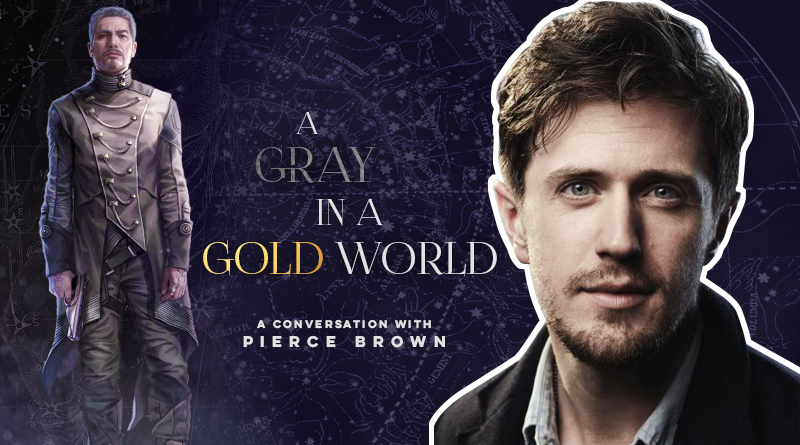
It’s not every day that you get to sit down and interview someone whose work you admire. I first heard about Pierce Brown’s debut novel Red Rising while listening to the radio. I had tuned into the Elvis Duran morning show on Z100, and one of the cohost’s at the time, Bethany, mentioned having read the book. I’ve always been a long-time fan of science fiction. It speaks to the part of me that longs to stand in the sands of Tatooine, staring off at a binary sunset. However, exciting, new voices in the genre can be challenging to come across—especially as so many feel like a played-out retelling of a classic. So when I finally purchased Red Rising and sat down to read it, I felt like I had struck Gold (pun intended for all the Howlers reading this).
It is the sort of book where you find yourself—late at night on a work night—muttering the avid reader’s mantra of, “Just one more chapter.” And it is also the sort of series that leaves you in a lingering depression, knowing it will be another year before the next installment. With the first volume published in 2014, the story of Darrow and his comrades has become something of a time marker for me. I moved to New York that same year and have been reading a Pierce Brown novel for almost each consecutive year. And there is something special about growing alongside the Red Rising Saga as it unfolds, much like the way a young reader matured with Harry Potter.
If you’ve not yet read the books, the first trilogy centers around the main character of Darrow, a Martian denoted as a Red in a caste-based society. In this society, your Color determines your class—and, to some extent, worth. Reds are at the bottom and Golds preside at the top. Therefore, when we first meet our protagonist, Darrow is already at the lowest social rung and the highest level of oppression. He has been sequestered away from Society, living a subterranean existence as a Helldiver—which is just about the most someone in his position could hope for—but as any good series would have it, his journey takes him from young, conflicted teen to war-seasoned imperator.
The second trilogy, beginning with Iron Gold, was released earlier this year and expands the narrative beyond Darrow. The Solar System, once under Lunar imperial rule, is now divided as per the fallout of the Rising. An operation of liberation has only yielded resentment and chaos, and we see this through the eyes of Lyria of Lagalos—another Red like Darrow— Ephraim ti Horn (a Gray), and heir to the Lunar throne, Lysander au Lune. Lysander is a Gold with a very interesting story. If he had a Facebook account in the age of the Society, his relationship with everyone close to him would be labeled as “it’s complicated.” But that is the real beauty of Brown’s writing. He does a wonderful job of bringing to life every character in his series in the most humanly complex way. You really get a sense of who the person is, what motivates them, and what obstacles in their lives weigh them down. His women are fully-realized as well, serving as tactical minds as opposed to wilting love-interests. Virginia au Augustus (or affectionately known as Mustang), in particular, remains one of my favorites in the canon for the fact that she operates more as a critical piece of the war game than a bedfellow to Darrow.
But beyond Virginia’s strategical prowess, Darrow’s perseverance, and Lyria’s sass, there was something about Ephraim that grabbed my attention—he is gay. Not only is he gay, but he is one of the leading men in the narrative of the new trilogy. You might think, “what an interesting thing to focus on.” Usually, yes, it would be. However, so often characters of minority are sprinkled in around the perimeter of blockbuster fiction, that they’re usually treated like set dressing or extras in a movie. They may be given a few lines—or no lines at all—and meant to inform the audience that, “hey, this is a diverse world!” Yet, the same social barriers exist in that universe as they do in this one. The token character is usually a friend or a friend-of-a-friend, and don’t get much information about them as they generally do little to drive or affect the story. So, when a gay character takes focus and is written by someone who doesn’t identify in that way, it makes me curious.
And, fortunately, I had the chance to get to the bottom of my curiosity by asking Pierce Brown himself at this year’s New York Comic Con.
After obliging me to a few minutes of his time, I met Pierce in the autograph area of the Javits Center along with his editor, Trish Narwani. If you’ve had the privilege of attending one of his book signings, you’ll know that the both of them are incredibly nice. It’s the same when meeting them one-on-one. They welcomed and invited me to join them behind the signing table where Pierce and I sat to the side in order to be out of the way.
NP: Pierce, thanks so much for giving me some of your time. I really appreciate it. I’m here because I wanted to ask you about the character of Ephraim in Iron Gold. Does him being gay intrinsically affect his story in any way? Or, I guess, the best way to say this is, why is he gay?
In retrospect, and to Pierce’s credit, it was an interesting question. If someone were to ask me that—Why are you gay?—my answer would be: “Because I am.” Discussion closed. But what I had been trying to get at is, “Why did you make Ephraim gay?” Why would a straight author—who seemingly has no need to—introduce a gay character in his story? To reiterate, I love what Pierce has down in his books, so this was not meant as an interrogation, but more as a means of understanding motivation, if any.
Pierce Brown: The common saying is “write what you know”—and I know a lot of my friends, right? And so you write from your personal experience, based on people you surround yourself with. So to me, it’s almost a funny question, “Why write a gay character?” Because I know a lot of gay people. So I don’t think of it as—I didn’t intentionally set out to write a gay character to create representation. It’s just a happy byproduct of the people I surround myself with in my own life. And I first thought of him as a character. So, it didn’t really factor—If you look at it when you read the book, it doesn’t affect his storyline in any other way. He’s a person who’s in love, and he’s lost someone he loves. Why does that make him any different than anyone else? So I think it’s important to write a character that is honest to themselves, and whether they’re gay or straight, that often isn’t the defining principle of one’s life. There are so many other things that affect and influence him as a human being besides your sexual proclivity. I think that if I made that the focus of his character, then I think that would be doing a disservice to the Red Rising world—because it’s a world where the hetero-normative lifestyle we have now doesn’t exist. There’s a lot of fluidity in the Red Rising world, mostly because they’ve been influenced by Greco-Roman culture in which they had a lot less boundaries than we do today because of the influence of, you know, the Judo-Christian background of our country. And so, what I’m simply doing is writing a character who is honest to that world—who happens to be gay. And does it affect his choices in his world? Sometimes. And sometimes in his world he does deal with people who… For instance, the Red culture in his world is a hetero-normative culture, and so he has more defensive mechanisms towards them because he knows that they look at it as something that’s unnatural. Yet, if he’s around everyone else, no one else does. So, it’s not something that ever enters his mind. So, what’s interesting is, to me, is seeing how someone who’s never had to deal with, basically, being ostracized for being gay, is now looked down upon by the new social class, which is kind of rising from the rebellion. And those are the good guys, you know? But they’re the ones that also accept a relationship between a man and a woman as being the only form of love, basically, because that’s what they were taught in the mines. And it’s a backward mentality, and the rest of the world knows it, but it’s an interesting way of looking at it from his perspective by being, “No, no. This is the normal side!” And, so for me, writing a character for Ephraim, I first started with just the—I didn’t really realize that he was gay—I mean, he was gay—but I didn’t realize that was a different point until people told me. And I guess that’s where I wish that our, uh, culture was at. So, I think you write from a place where you wish culture had already reached.
NP: So, the reason why I ask, like, why write a gay character, is that so often you do write from experience, and speaking as a not straight white male, like, I feel as if there’s no need or necessity to do so, you know? More often than not, people don’t do it.
PB: Write outside their experience?
NP: Yes. So when it does happen, it just kind of—for folks like me—sends off a red—not like a red flag, but, like, a marker that somebody else is also, uh, raising awareness to your existence in a way that hasn’t yet been done so before.
PB: If you look at it from, like, uh, ten thousand feet up, right? Harry Potter… let’s use Harry Potter as an example. Harry Potter is a character who is like a vessel. You know, you occupy him and you explore the magical world. He’s basically the person that carries you through it, yet a lot of people can’t relate to him because they have a lot of differences from him—being his sexuality, him being a boy… A lot of readers are girls, you know? So, I think that it is only natural for someone writing and for art to have more vessels for people so they can find a commonality with themselves to say, “Oh, I relate to that, so I relate to this character.” It’s basically creating a vehicle for someone to be like, “I identify with that person.” I mean, if you look at it from that perspective, why shouldn’t everyone have someone that they can relate to on that level?
NP: Right. Again, hopefully it’s not the thing that defines him, Ephraim, in this case—just like he’s existing in this world, living within the parameters that are already set up and the oppression comes in so many different ways—
PB: So many different ways, yeah, yeah. What it does then, for me, it makes me explore all the other facets of his personality. And, his sexuality is almost the last thing on his mind because.. he’s not changing. He was born that way, so he’s not changing. So, it’s all the others things he has to deal with.
NP: Do you find experience from modern events and culture that kind of find their way into the Red Rising anthology?
PB: To a degree. To a degree. I think that—one thing that oppression has is the similarities in which it’s enforced and the effects it has on a human being. And so, for whatever reason you’re being oppressed, for whatever difference people decide to create tribes around—whether it be skin color or whether it be sexuality or whether it be gender—the results of that oppression are very much the same in terms of limiting people’s expectations of themselves. In terms of, um, questioning people’s self-worth, and creating this culture of self-incrimination and self-reformation, basically. Basically, making the self hate themselves because you’re not accepted based on what society values. And so I feel no matter what they decide to make the tribes out of, that feeling is the same. So, in many ways, exploring a hierarchy and class system in the Red Rising world mirrors ours in terms of socioeconomic status, in terms of, um, uh, gender roles… In terms of gender binary, et cetera. And you’re able to explore the overall effects of oppression from a politically neutral view in a lot of ways that doesn’t alienate… Cuz, you know, if you write about current issues, people already have their stances. And then their counter-arguing you the entire time. But instead, if you can make them understand what oppression is and what the plight of people is, then perhaps they can be more sympathetic to the people in their world…And they apply this thing that they learned in a science fiction book to how they treat other human beings. So, that’s what this is all about. It’s about how human beings treat each other. We’re always going to choose something to hate about someone else, because… Because it always comes down to insecurity. You know, it comes down to insecurity because the mass—the large sections of society—will not like something or talk down about something or legislate something because they feel threatened by it; because it threatens their own insecurity, right? That’s where a lot of this ostracism comes from. And it threatens it because of either, like, something that they learned when they were a kid, some societal norm that was accepted, or perhaps religion, and so then they war against it, and then the minority suffers. I see that as something that is common throughout the human experience. It just so happens that we’re lucky enough nowadays to be focusing on issues like some character’s sexuality. You know, it’s about time, but I also think that it’s important to realize these are characters, you know? And they’re human beings, and that’s the entire point. So when I say I accidentally wrote Ephraim as gay, he was never anything but that. And that’s how people are in real life. So, it’s almost—It’s almost a hilarious question, and I know you can see that, too. (laughs)
NP: (Laughing) Right. I mean, it is, but yet it’s not. Because, like I said—
PB: Because it is a choice. Because I wrote it.
NP: But it’s also the representation that comes behind it, right? It’s just like, when you are a writer, right, just as you are… a person—when you do something it elicits a reaction, right? Even if it’s in a fictional world and you create something or, like… One of my favorite stories to tell is… You’re familiar with Elizabeth Gilbert?
PB: Mmhm. (nods)
NP: When she was doing her tour of Eat Pray Love, uh, she was doing a book signing and a woman had come up to her, and she’s like, “Thank you so much for writing Eat Pray Love, like, that section where you talk about getting out of your abusive relationship”… She’s like, “That gave me the impetus to get out of mine.” And Elizabeth Gilbert, like, took a moment to be like, “Okay, well there’s nothing about an abusive relationship in Eat Pray Love…”
PB: Look at that projection…
NP: Exactly, yeah. You know, but she was able to check herself in the moment to not say anything, right? To not overcompensate and correct this woman because that was the healing that the woman found in the book.
PB: And that is the ultimate reward for an author, I think.
NP: Right? So, it’s like… I guess the other thing that I try to navigate is… How much of it is social duty and then how much of it is, “This is just.. I’m telling the story that I have to tell?”
PB: It’s an interesting question. I feel almost like my social duty part comes retroactively—I think about it more afterwards because I’m telling the story I want to tell. And then I start seeing the effects and how it’s affecting people in terms of, like, someone identifying with Darrow, someone identifying with the character and it helping them through a personal trial. A lot of my most important letters that I get come from people who read it at the bedsides of ailing relatives, or people that they’ve helped them through chemotherapy, or through the death of a father or something like that. And so, when you find that emotional resonance—it comes afterward. It wasn’t intentional. I wasn’t trying to coach them through chemotherapy. Um. But when it comes down to something that is a hot-button issue, it is different. And I think all I can really do is draw my line in the sand of what I think is socially acceptable, and draw my morality in the sand, and represent it in my characters, and what I see as the world…the way in which I treat my characters is the way I wish we treated each other, and so I think that the only thing that an author could do is, not preach, but have their story be a byproduct of their world view. And I think that’s much more influential. Because if I’m preaching, what’s my experience? I don’t know the gay experience. I don’t know what it’s like to be a woman of color. But I can write a character that is honest to themselves and, hopefully, reflect something in the human experience in that. But I feel if I do consciously take on the idea of preaching, then all the sudden I’m entering a different category. Because then I’m trying to tell people who deal with this, who suffer with the stigma or the, um, negative externalities of being different in society, I’m trying to tell them it’s like it. I think that’s bullshit. So, all I can do is write a story about a person and hope that it connects with other people.
NP: It’s almost as if, like…You can’t write from somebody else’s experience, right? All you can do is kind of…create the character—the human—and then sort of pay homage to the things that make them different.
PB: Hundred percent. And I think that’s—for instance, I have a big following in the military. I write military books, but I’ve never been in combat. But they like the things things I’ve written that they identify in there, but I’m also not pretending to be teaching them anything. I’m not pretending to be telling them something or lecturing them. But I think that is something that really alienates me, when another author is trying to teach me something from a holier-than-thou standpoint. And that, sometimes I find, can ruin the story and the effect of the message, because then you’re seeing the author instead of seeing the character. And I think it’s so important to see the character, and think of Ephraim as a human being first, and all the other stuff second.
NP: Yes, of course.
Our conversation turns toward Star Wars and recent release of The Last Jedi, which was slammed for pandering too much to the Social Justice Warrior. The point I was trying to get at was how characters can sometimes become more a representation of an idea than of a real person, but surely there is a way of merging the two: creating characters that uphold representation as well being fully-realized people with more complexities than just a single defining factor such as race, gender, or sexuality.
I jump laterally across to Afrofuturism, which is an “art form, practice, and methodology that allows Black people to see themselves in the future despite a distressing past and present.” (source) I don’t know of a movement similar to Afrofuturism for Queer folks, but I wish there was. Again, this is the whole reason for my interviewing Pierce, because it isn’t typical to find Queer characters taking the stage of their own extraterrestrial journeys. It’s the idea of saying, “not only do we exist in the real world, but we exist in the fictional as well. We get to be superheroes and witches and wizards and all the other things beyond just the civilian.”
NP: Coming back to Harry Potter, I thought it was interesting how J.K. Rowling released that Dumbledore was gay after the fact, right? I sometimes wonder why that was a post facto thing that we get.
PB: I sometimes have trouble with retroactive inclusion. If you meant it…You had seven books. And I think that then separates the intention from the story itself, and that then makes it an argument as opposed to loving a character for being gay, you know? For being that character. And then all the sudden, “Here’s a character you love. He’s gay!” Then it seems like, “You’re fucking with me.” It’s almost like… how do I say this? It’s almost a little underhanded to the gay community to me.
NP: Well, I’m curious because the new movie Crimes of Grindelwald is moving into—I’m curious to see how they play off the relationship Dumbledore and Grindelwald because it was known to be more than friendship.
PB: I do like that element. Because it does make Dumbledore… It makes him interesting. It creates so many complexities to dealing with the villain—towards, you know, how does he solve this issue? Towards Dumbledore being so isolated. And I do like that in terms of how it informs his character. I think there’s no reason not to show during the actual writing of the book.
NP: Exactly, but my thing is now that we know that information—it’s not really in writing—can you step up to the plate and actually create this character in a three dimensional world that actually has him fill those shoes? Like, now you have to go back and do the work—if that’s the story we’re investigating, I kind of want to see that.
PB: Out of curiosity, what makes you feel like it’s a disingenuous representation? Something that triggers like… Cuz you know you have a bullshit meter built into you, you know? Where you can be like “Ahhh”—where it feels like they’re either not being represented properly or they’re abusing it. Do you feel that often?
NP: It always comes down to what is…palatable, right? Like what most people can tolerate. I feel this specifically with Queer cinema. Like, for example… Last week I went to a play reading where a friend of mine wrote five short plays about the Black female experience. And, at the end, there was a talk-back and one woman said, “I love this. I want to see it produced on Broadway, all of this stuff,” she goes, “my only concern is that it’s not White enough.” It’s not White enough to get the traction. So, like, that kind of sums up the whole idea for me where it’s just like… it’s not palatable enough. People aren’t able to digest it in a way that’s like, “Yeah, I can take it because it’s micro-dosing or, like, a tolerant amount.”
To explain, there is often something that comes with mainstream Queer media (certain things aside) that caters more to the straight audience by way of making the content digestible. This is the point I was trying to get at regarding my friend’s piece and the comment about it not being “White enough.” Because somehow the work must be changed so that the majority does not feel threatened by it. When Queer content feels watered or tamped down, that is when my bullshit meter goes off.
PB: I rarely focus on the romance of my characters. My books aren’t about that. They’re about other things. So, you know, no matter what the character is, it’s not kind of the central focus of their story. Even Darrow, the main character, is usually doing things—First is his wife, but everything else is a logical concern; not based on a romance. I just don’t focus on that. And I feel like, cuz I’ve had gay characters in my stories before. Quicksilver, one of the pivotal figures of the Rising is gay, and Matteo. So they’re populated all throughout. It’s rarely touched upon, you know, how that affects their personal lives except that they are. And I wonder if that is, as we talked about, palatable enough. Because I’ve never had anyone raise any issues ever about me having gay characters in my books or being a Social Justice Warrior.
NP: Well, the other thing is that you’ve actually committed to putting it in writing.
PB: Yeah, you’re right. If I tweeted about it, it would be a different thing. Because then people—I think here’s what it is. People react then and like, “Okay, you’re retroactively trying to sneak something in on us instead of just treating us like adults.”
NP: Which I’m not—there’s no shade towards J.K. Rowling at all.
PB: No!
NP: It’s just that… That wasn’t in writing until after she said it, and now I’m just like, “Can you commit to what you said?”
PB: It just makes me raise an eyebrow if they tweet it, but don’t write it. But now that it’s in there. I think she wrote the script.
NP: She wrote, I guess it’s gonna be a five movie series.
PB: Jesus. Do we need five movies? (laughs)
NP: (laughing) That’s a whole different argument. But… The thing is, I’m just curious to know how much of that [Dumbledore and Grindelwald’s relationship] plays a part, because—
PB: A lot if it. Personally, that’s not the kind of writer I want to be. You know, I want my story to speak for itself. And I want people to have their experience with it. So, if someone interprets something in my story, I don’t want to correct them and say, “you’re wrong.” Because stories are about personal experiences you have with the text; personal experiences you have with the author; personal experiences with something you have created. And I think it would be a shame if I was looking at a Renoir painting and he came up to me and said, “Oh, it’s not what you think it is.” I’d just be like, “Alright. Well. Thanks.” And so that’s the power of stories. That’s why we’re seeing representation in science fiction and fantasy and all these things is because… the person is forced to then confront it, and see how they accept it or don’t. And I feel like that’s the best method of winning over an audience, you know?
NP: It’s almost like, if you can tolerate it in the world of make-believe maybe you can—
PB: See this is the whole point of my series. The whole point of my series is to talk about social problems of the day in a different setting that isn’t telling you what to think now, but just saying “think about it.” And I think that’s all an author should do.
It’s true. As writers, we hold a responsibility to not tell people what to think, but to simply encourage that they do—perhaps about things they have not otherwise thought about before. Therefore, as a conclusion to our chat, I asked Pierce which new authors in the space we should look out for.
PB: Well, Chuck Wendig is one. Um, he’s doing a new book with Del Rey. He’s a terrific writer—what is the bird book he wrote?
Trish Narwani (Pierce’s editor): Blackbird.
PB: Blackbird! Which I really liked, yeah. So, Chuck Wendig’s fantastic. Who else? And Alyssa. What’s Alyssa’s last name? She had that really good book about the Japanese eating of the babies and souls, uh…
TN: (laughing) I don’t know if I know her…
PB: Alyssa Wong.
TN: Alyssa Wong! Alyssa Wong, right. She is incredible! She is a genius.
NP: What is the name of that book?
TN: She’s only done short stories.
PB: She does short fiction, but she writes, like… really evocative, cross-cultural stuff. Basically, like, magical realism horror. Oh, and uh. V.E. Schwab.
NP: Awesome. Well.
PB: Thanks, man!
NP: Thank you!
If you’ve not yet read the Red Rising, you can find the link to Pierce Brown’s series as well as all the referenced authors below. Give them a read, and let me know what you think. Perhaps the next addition to Typed Out will be a book club! And if you know of an author writing about minority representation, please let me know!
Red Rising series by Pierce Brown
Blackbirds by Chuck Wendig
Short Works by Alyssa Wong
Shades of Magic series by V. E. Schwab