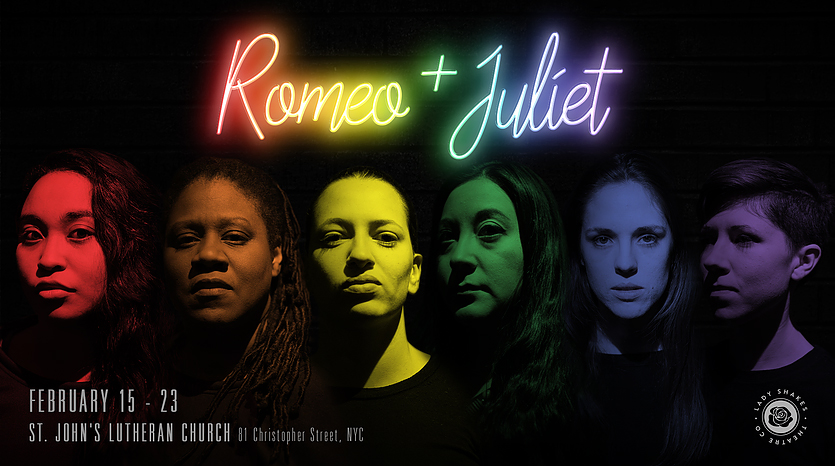
St. John’s Lutheran Church rests on the corner of 7th Avenue South and Christopher Street in New York City’s Greenwich Village, roughly four hundred feet from the historic Stonewall Inn where, 50 years prior, a series of riots set off what is now the Queer & Trans Rights movement. It’s an unassuming place, one I’ve walked past several times without ever clocking its existence. Never had I a reason to walk in until last night.
It just so happens history is happening once again as William Shakespeare’s fated tale of the star-crossed lovers is resurrected with a new infusion of female queerness, and it is exactly what has been missing from classical theater.
The Lady Shakes Theatre Company‘s inaugural production of Romeo & Juliet is deceiving—deceptive only because you would not believe this is the all female-identifying cast’s first dance with the Bard. Director Martha Benson—who also stars as Romeo—demonstrates a clear understanding of Shakespeare’s text, which comes across both in her delivery, as well as her directorial approach to storytelling. Scenes otherwise left to dialogue are fleshed out with added nuance—a body in Friar Lawrence’s (Esther Williamson) cell; the overlap of Juliet’s (Imani Youngblood) famous monologue with the death of Tybalt (Renata Soares); and the planting of Juliet’s fatal dagger. These touches bring something new to what is arguably one of the most-studied and most-produced theatrical texts, and because of the frequency with which Shakespeare is performed, this is no easy feat.
At its core, Lady Shakes’ Romeo & Juliet is a beautiful reconstruction of the world-renowned tale. What I enjoyed most was the way in which gender transformed and unlocked certain elements of the text. Romeo, presenting as a woman, finds grounding in her passion; breaking past the typical emotional binary with which the character is so often played. No longer does she operate on a strict switch of sadness and love, but Benson’s portrayal imagines the whole ocean in between. In fact, one of the production’s best scenes happens to be unscripted. It is an incredibly raw and tender moment following the death of Mercutio (Caroline McCaughey) and Tybalt. After consulting Friar Lawrence, our fated protagonists reunite for what will be their final moments of joy, and the consummation of their recent marriage. But Benson’s direction threads together the events in a way that shows mastery and understanding of not only the text, but the human experience. Hard-won are our greatest triumphs on the heels of our monstrous deeds, and so Romeo’s pain and remorse for having killed the cousin of her lady love is beautifully exemplified upon her return. She falls at the feet of Juliet, substituting a sob for iambic pentameter, as she seeks forgiveness for the familial blood that stains her hands.
It’s a poignant, directorial segue in the text, fleshing out the wholeness of two, well-renowned characters. It is this scene alone that elevates their love from what is commonly perceived as juvenile, to a connection that is more genuine and mature. And for this production, the maturity of Romeo & Juliet’s love means everything.
Beyond brimming hate between households, we have two women’s lives colliding together. Juliet, alive with girlish fervor in Youngblood’s skilled hands, is lifted above trite naïveté. Though first betrothed to a man, her sense of self-understanding is ignited upon meeting female Romeo—the linchpin moment that will resonate profoundly with Queer audience members. Suddenly their love becomes both an awakening and a provocative point of tension amidst their respective kin; particularly the scene where Lord Capulet (Erin Mansur) threatens to disown his daughter for her disobedience and sullying of the Capulet name—an all too true reality for many Queer youth, especially Queer youth of color.
Adding to Romeo & Juliet’s fated unfurling are Nurse (Joyia Bradley), Benvolio (Starr Kirkland), Mercutio, and Friar Lawrence. There’s something about seeing each of these roles portrayed as women that elevates the story—infuses it with new understanding. Bradley’s take on Nurse is one of the most enjoyable and vibrant I’ve seen. Her delivery is nothing short of mastery—snippets of image-laden storytelling are fully realized, and never once does Bradley overemphasize her point with wild gesticulation, as is so often the case between actors and Shakespeare. She is present, even when recanting the past, and the flighty nature of Nurse bubbles up from her center—flipping back and forth between thoughts without ever losing the audience. And, when the story calls for it, she adds necessary gravitas, making you realize Nurse as Juliet’s only real mother and an embedded member of the Capulet household.
Also standing at the crux of the lovers’ untimely death is Friar Lawrence, who is most often pinned with mishandling the situation. However, Williamson’s portrayal of Lawrence as a woman of the cloth relieves her of this mantle, and instead allows the events to unfold as one of true misfortune. Rather than appearing as irresponsible, Lawrence is sagely and wise in her advice to Romeo & Juliet. You believe the authenticity of her care and concern—that she is truly trying to help, as opposed to blundering at pivotal moments along the way. So, when she arrives at the Capulet tomb in the final scene, her heartbreak of witnessing Juliet’s final moments becomes all too real.
As members of Romeo’s consort, Benvolio and Mercutio should not be left without mention. Mercutio is beautifully embodied by McCaughey. As the ribald, tagalong knave of the Montague troupe, Mercutio is often overplayed as a vulgar buffoon—but there is no clowning here. That is not to say McCaughey lacks exuberance. As a matter of fact, she is a delight to watch—sprightly stepping into the action with a costume and hairstyle that blurs the lines of gender. This androgyny is something you never knew you wanted in Mercutio, and brings balance to what could otherwise be perceived as schoolboy antics. And upon her mortal clash with Tybalt, it is Benvolio’s heart-wrenching reaction that leaves you feeling gutted. Neither would the two events hold any sway had the performances of each of the actors not been so adeptly portrayed.
Though the fate of Romeo & Juliet was an unhappy one, the opposite can be argued for the company. I believe the Lady Shakes Theatre Company’s future will be bright, especially if they continue to hold Shakespeare’s work to such high regard. It also makes you wonder why it has taken nearly five hundred years for these roles to finally land in the hands of womxn. Nevertheless, I’m glad the day has arrived.
The Lady Shakes Theatre Company’s production of Romeo & Juliet opens the theatrical season for St. John’s and runs until February 23. Tickets can be purchased via their website here. For more information, visit www.ladyshakestheatreco.com.
Romeo & Juliet
Lady Shakes Theatre Co.
February 15 – 23, 2019
St. John’s Lutheran Church
81 Christopher St, New York, NY 10014
www.ladyshakestheatreco.com