Book Review
Don’t Let the Forest In
C.G. Drews
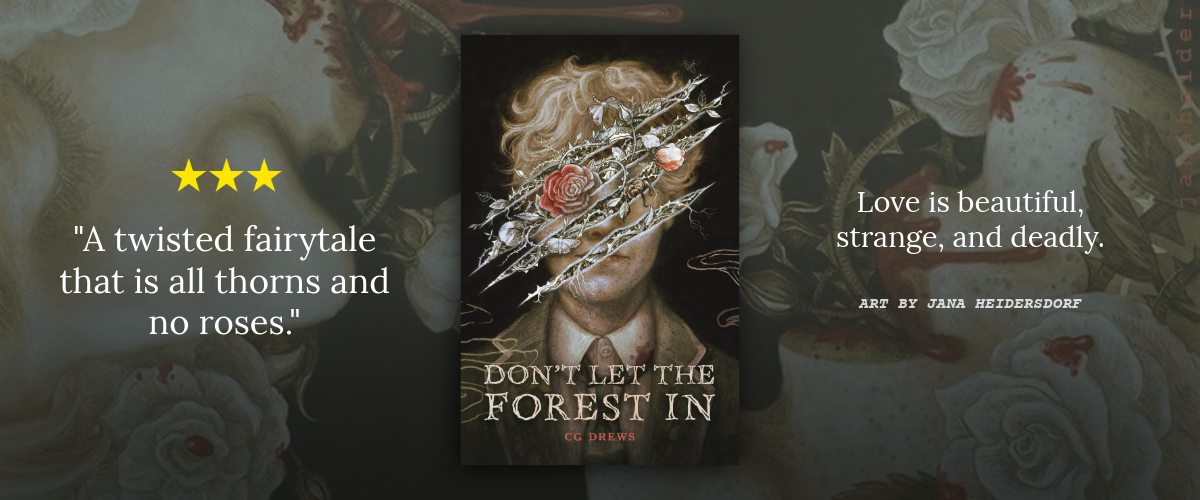
I found Don’t Let The Forest In on its own little side table near the Young Adult section of Barnes & Noble. I loved the cover—and honestly, what is not to love about it? Jana Heidersdorf’s artwork is stunning. (It is really nice to see book covers that still use hand-drawn art.) So I picked it up and read the description on the back, which reads: Thomas had no idea Andrew would do anything for him. Protect him. Lie for him. Kill for him.
My interest was piqued. Beautiful artsy cover, queer romance, dark fantasy element—sold. Quite literally. I brought it up to the counter, paid, took it home and—well, as you hopefully do with books—read it.
At the book’s center is Andrew, a high school senior who attends Wickwood Academy along with his twin sister Dove. Completing the trio is Thomas, the haphazard, misunderstood artist type who Andrew is infatuated with despite there being some history between Thomas and his sister. The three of them have returned to school for their final year, but even at the start, things are not going well. Something from Andrew’s past is haunting him—a secret held until the eleventh hour—and Thomas is suspected of murdering his own parents. However, nothing becomes more pressing than the monsters they discover in the forest near school—monsters that Andrew writes about in his stories and Thomas illustrates to life.
I really wanted to like this book. Or, let me say, I wish I could have given it a higher rating than three stars. The first hundred pages had me, and although I had to set it down for awhile, I was eager to get back into it. I found the mystery around Thomas, the murder of his parents, and the origin of the monsters all intriguing. The tone (and the setting) of the story very much reminded me of Wednesday, though without the humor and charm—dark, eerie, and edging toward horror. However, what begins as one of the largest plot points in the book goes nowhere. At least, it doesn’t go where you think it will. And while that might sound like a good thing—subverting expectations—it is the sort of twist (or plot hole) that removes a bit of believability. As a matter of fact, there are two moments in this book—one in the beginning and one in the end—where this element is used and it backfires again. Simply because the breadcrumbs have been laid out a little too cleanly for this sudden trap to work, only to find out it wasn’t a trap at all as the mechanism is completely undone two minutes later. (Check below in the Spoiler section for details.)
While I ultimately didn’t find the plot to be as satisfying as I’d hoped, that doesn’t mean this book is without its merit. Author C.G. Drews is a talented writer and despite losing interest in the story here and there, I always found the prose to be poetic and strong. Notably, their descriptions of the forest and its elements really stood out. Every time it crept off the pages and came to life in a way that felt like you could feel, smell, and taste it. Conversely, their monsters were a bit lackluster. Easily defeated and never present long enough to sustain the tension. I would have preferred them to be more haunting and for there to be more consequence to their existence.
In the end, I found Don’t Let the Forest In to be a twisted fairytale that had more thorns than roses. A happy ending isn’t always needed—nor possible, as is true to life, but the payoff never quite seemed to match the promise. And that’s where this book fell short for me.
There were a lot of things I didn’t particularly care for in this book. One, I found it difficult to like or sympathize with Andrew. You don’t always have to like a main character, but you should at least sympathize with them. As a reader, you are following their journey and hoping to witness change by the end, and sympathy/empathy plays a large role in this. Without either, I don’t believe you have much for a compelling story. Andrew didn’t make Drews’ novel unreadable, but I found myself often losing interest in his story. I’m still unsure if he really loved Thomas or if he was just narcissistic and manipulative. Obsessed might be the best-suited word.
Then there were the monsters. I wish they were scarier, and I wish they held more of a purpose. If they had one, it was very lightly implied. Including the illustrations for the monsters was a nice touch, and the artwork often reminded me of Scary Stories to Tell in the Dark, which were terrifying by the way—but I never felt like they affected much. At least not in a way that was concrete. Yes, people died (and they didn’t), but those deaths or attacks were simply ignored. So, were the monsters real or not? Were they just manifestations of Andrew’s depression/insecurities/subconscious or not? You can’t have these things just chilling in the woods sometimes and then ravaging the school and killing characters when they feel like it? So is the threat constant or not? The reveal of what was bringing them to life was also anticlimactic. It was apparent Thomas’s drawings were never the source. At least after the second attempt. Why did the characters never think to link the monsters to Andrew when they were his creations to begin with? That should have been obvious.
It became very apparent that Dove was dead after the second or third hint in the final act of the book. It did feel like this development came a little late and out of nowhere, but by the time you saw it coming, the second “bait and switch” happens. Dove, a ghost of her brother’s imagination, leads him out into the woods. Here, she tries to convince him that Thomas is the one he’s made up this whole time—that he was arrested for his parents murder early on in the book and that all the rest was just a fever dream. But it doesn’t work. The whole scene is thin and transparent as the other characters have already made it plain that Dove is the one who’s dead and they’ve also interacted enough with Thomas for him to be real. So, the attempt at subverting the actual secret—that Dove died their previous year at school as a result of an accident in the forest—is entirely futile. In the next scene, Thomas reveals Dove’s fate only for it to have no impact. I admire the idea, and it could have worked, but I don’t think this execution served the plot any.
And then there was the ending. Did Thomas die? Did he not? Did anyone at the school really die? Did they not? Was Dove the only one who was actually dead? Were the monsters real? I guess they had to be if Thomas’s parents were dead and they were supposedly responsible for their death. So many questions unanswered. Far too much ambiguity.