Book Review
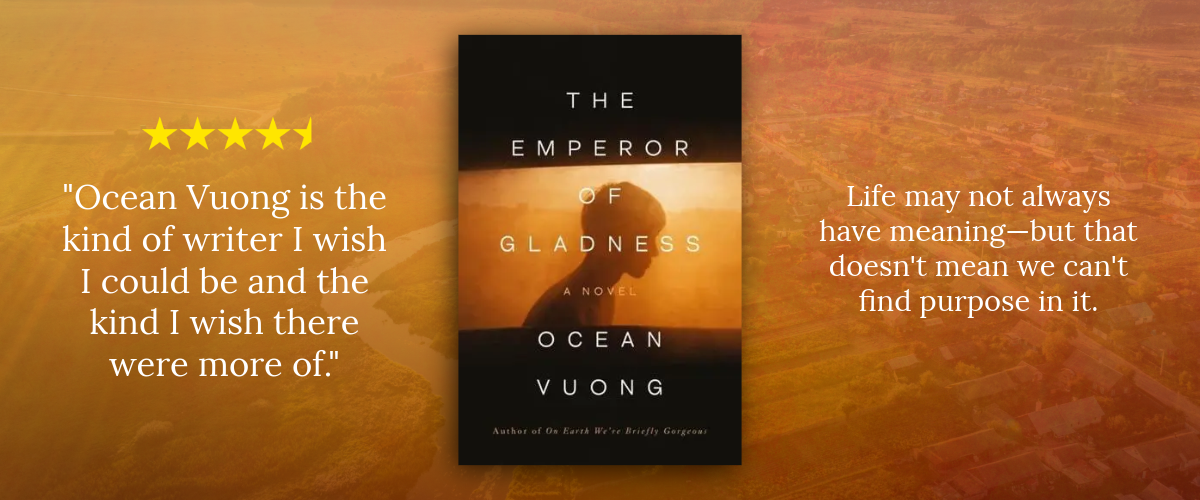
The Emperor of Gladness
Ocean Vuong
Ocean Vuong’s The Emperor of Gladness is the kind of book that you hope to find when you walk into a bookstore—beautifully written and deeply meaningful, with characters that burst off the page and come to life in ways that make them feel like people you know (or have come across somewhere in life). Never a trope, but representations of the various lots we all receive in life, each of Vuong’s characters serves a distinct purpose: to remind us that life may not always have meaning—but that doesn’t mean we can’t find purpose in it.
Unlike most, I didn’t hear about The Emperor of Gladness through Oprah’s Book Club. I heard about it because a good friend happens to be the audiobook narrator (James Aaron Oh). So I downloaded and listened in support. James’s narration is superb. He does an incredible job of bringing each of the characters to life, all with their own distinct voices. It’s no wonder his performance received a nomination at this year’s Audies. And if audiobooks are your thing (and even if they’re not), I highly encourage a listen.
Based in the fictional town of East Gladness, Connecticut, The Emperor of Gladness centers around Hai, a young Vietnamese-American man in his early twenties. When we first meet Hai, he’s at his lowest, and the decision to take his life is swiftly interrupted by an elderly Lithuanian woman by the name of Grazina. Pressed together by life’s circumstances, the two form a fast bond—each needing the other for various reasons. Grazina needs a caretaker and Hai needs someone to help tether him back down. Their story unfolds in myriad unexpected ways, with a supporting cast of characters each infused with their own quirks and views on life. But through it all is a parallel drawn between two people whose lives couldn’t be more seemingly opposite—a young man managing grief and addiction and a woman whose dementia sends her hurtling back to memories of escaping her home country during the Second World War. Each of them displaced, each of them in search of the people they’ve lost or forgiveness for the mistakes they’ve made.
What struck me first about the book is how poetic the language is—not in a way that is overly flowery and hard to grasp, but the way that reminds you of how beautiful (and tragic) the world can be. One example is Vuong’s use of color. Like an artist, he uses hues by such distinct names that they immediately take you right where he wants you. The sky at night. A hazy summer afternoon. The barren, cracked parking lot in a rundown American suburb. There is never any ambiguity in his language. Nor in his crafting of story. Vuong is so economical with his words, that each one feels intentional, purposeful. Briefly put, Ocean Vuong is the kind of writer I wish I could be and the kind I wish there were more of.
You can tell he’s done the work—read the classics, studied writers from all countries and all walks of life; put in the hours honing his own craft. All of it distilling to his singular, unique voice. One that has the potential to define a generation. Like James Baldwin or Toni Morrison. Like Hemingway. What makes Vuong’s work so poignant is that it comes with round-edged commentary. Though not blatantly written into a single sentence, Vuong draws the reader’s (or listener’s) attention to the issues of the world by the characters he paints into it. Hai with his addiction. Grazina with her dementia and PTSD. Sony with his neurodivergence. BJ and Wade with their struggles to be seen in a country that assesses value by race. Maureen with premature loss. All of them trying to make the best of life with limited means.
The reason for not giving this book a perfect score is that there were a few moments where my interest was lost. The opening few pages were a bit too figurative, and it took me awhile to grasp where the story was set and who exactly was at its center. There were also a few jumps in time that disconnected me from the narrative, which made it a bit difficult to put greater events in context; however, in total, these are minor complaints. The Emperor of Gladness is still an outstanding book, and I have every intention of picking up Vuong’s debut novel, On Earth We’re Briefly Gorgeous.
I’m happy to consider Ocean Vuong one of my new must-read authors, and I hope you enjoy this book every bit as much as I did.