In the late 1970s, there was an unusual crisis of young children pretending they were Superman. They would tie towels around their necks and attempt to fly, jumping out windows or off their front porches. What these children learned quickly was that they couldn’t. Gravity is much more real (and dangerous) than the man with an S on his chest. But such is the power of make-believe. In fact, the incident around mimicking superheroes was so great and concerning, that it pulled Fred Rogers off hiatus and led him to return to Mr. Rogers’ Neighborhood, where he spent a week focusing on the importance of playing pretend.
As children, we have a young and impressionable mind. We are sponges, grasping and absorbing all that we see—and when we see someone doing something that fascinates us, we want to believe that we can do it to.
This isn’t a cautionary tale against superheroes, but it is a tale of seeing something in the world of make-believe that finds its way back to our everyday reality.
As a kid, I loved anything that gave me a supernaturally gifted hero—the X-Men, the Mighty Morphin’ Power Rangers, Transformers, Teenaged Mutant Ninja Turtles, you name it. If it existed on television, in a comic book, or as an action figure, I was all about it. Without a doubt, I was a child of the 90s spoon-fed on jacked-up G.I. Joes and Gargoyles. And there is a large part of me that still loves them, and we’ll get to why that is in another article. When a new Marvel movie hits theaters, my friends and I rally together, finding joy in the momentary escape. Who doesn’t love the jaw-dropping graphics and the increasingly mind-blowing CGI? And there’s everything to be said about a good, heart-pounding action sequence.
But as I’ve grown older and look back at my adolescence—or even today, at the plethora of superhero movies and television shows being churned out like Silly Bandz—I have come to realize something. Something, in particular someone, is missing. Me.
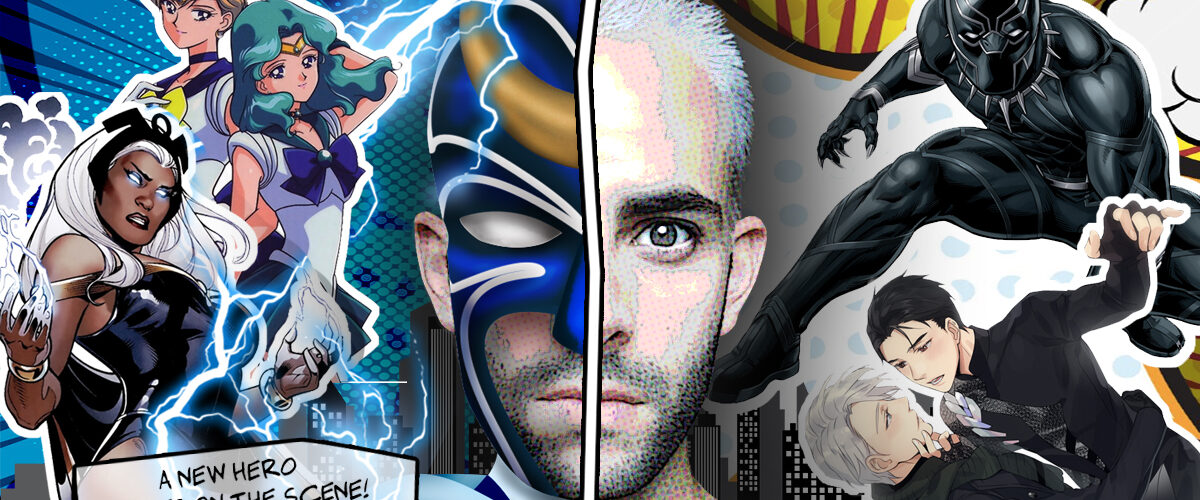
Except for a few tertiary characters (if they even make it to that level), there are no LGBTQ+ superheroes. Big box office companies would never dare to put a gay man, woman, NB, GNC, or trans person at the center of their own five-film franchise—not as a hero, and not unless it had the chance to possibly win them an award. What gay cinema there is is usually fraught with conflict and sadness and pushed to the forefront, not because it’s necessarily good, but because the subject matter is ‘edgy’ enough to make it award-winning potential.
How long has it taken for Black Panther and Wonder Woman to finally make it to the big screen? Superheroes first leapt off the page in the early forties, being turned into film serials—a series of short programs that would tell a story consecutively over several weeks. The first of these was Mandrake the Magician, which aired in 1939. So, to answer the question: 79 years. It took just a scratch below eight decades for a Black man and a woman to be given the spotlight in their own blockbuster film. Hopefully this is a learning lesson for the DC cinematic universe, because Wonder Woman is hands-down the best film they have ever produced and it could still be better.
While I’m thankful this movement has finally begun, I’m worried it isn’t moving fast enough. Marvel will be releasing Captain Marvel next year, leading us into the final chapter of the Infinity War saga, and while I’m happy that we’ll finally have a female-centric stand-alone from them, I can’t help but ask why Black Widow never had a three-film origin story and lead-in of her own? As of this year, Scarlett Johansson is the highest-paid female actor in the film industry. Her net worth is $140 million—an easy $30 mil over Jennifer Lawrence, who also has a huge box office draw. Which leads me to The Hunger Games. Amazing films. I had the privilege of working on one of them, and that entire franchise is second in the United States only to Harry Potter for YA book adaptations.
The total domestic earnings? $1.4 billion.
I’m not a millionaire—nowhere close to it—but that seems like a solid return on investment. So, at $40.5 million earned per film, you mean to tell me people would not want to see Black Widow in a series of her own? Why wouldn’t they? Johansson is a great action star, and she’s engaging to watch. And perhaps a three-contract solo gig with Marvel would have kept her busy and away from Ghost In The Shell, leaving the role of Major to someone who is more appropriate.
Something such as this leaves the lasting impression in the minds of young boys that women aren’t worth including—that it’s only the straight white men of this world who are the true heroes.
Also, to further touch on the blatant misogyny, why is Black Widow consistently left off of all Avengers merchandise? Something such as this leaves the lasting impression in the minds of young boys that women aren’t worth including—that it’s only the straight white men of this world who are the true heroes—and we’ve had far too much of that. I haven’t done the math on this one, but I’d wager to say it’s something close to at least a couple millennia.
And while the film industry has started its slow integration, there is still work to be done in the worlds of comic books, anime, sci-fi, and fantasy. This isn’t to say there aren’t comics or books or shows of this nature, but they are far and they are few. Even the gay characters are often secondary at most, and we’ve had a lot more exposure as a demographic in comparison to our fellow Queer counterparts.
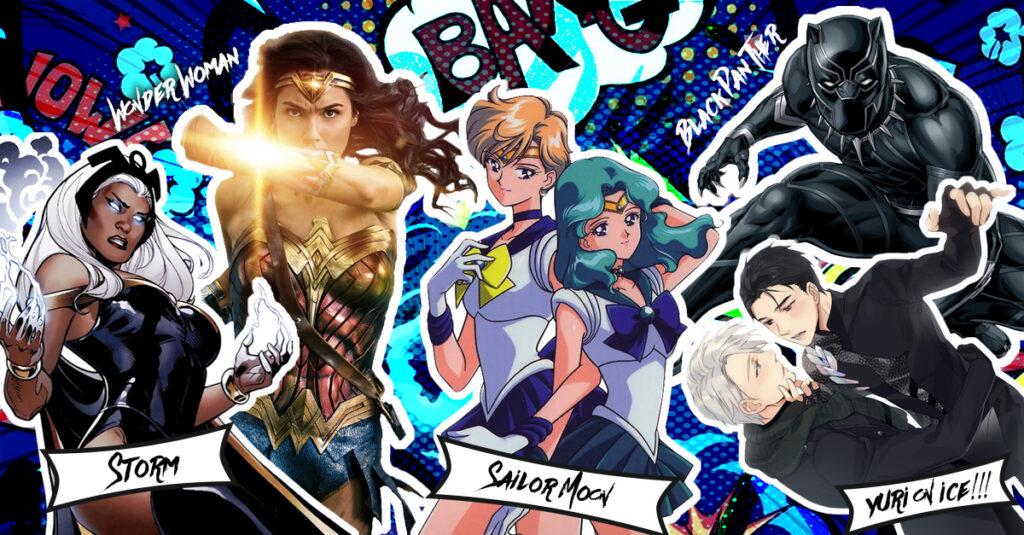
For anyone that knows me and knows me well, they know I love Sailor Moon. Perhaps a little more than any man in his thirties should, but we can microscope that in a later essay. Of all my childhood favorites, Sailor Moon is the only one that stands the test of time as being Queer-friendly and self-affirming. Why? Because it’s central characters are a group of strong, self-possessed femme characters who know that it is about working together rather than working alone. And while there is a male hero present, he never saves the day. Yes, he may alleviate a situation, but it is always Sailor Moon and her crew who triumph. What’s more, the manga prominently features a lesbian relationship (between Sailors Uranus and Neptune) and three trans characters who arrive in the final act of the series. The Sailor Starlights, much like Sailor Uranus, are male in civilian form and then transform into women.
I’m not sure Naoko Takeuchi really knew the power of what she was doing when creating Sailor Moon, but she tapped into something, and created a universe where a wider audience can find themselves. That is, unless you saw the original Canadian dub where the relationship between Haruka and Michiru was turned into an awkward cousin dynamic and the last season unreleased because the studio didn’t know how to handle men transforming into women.
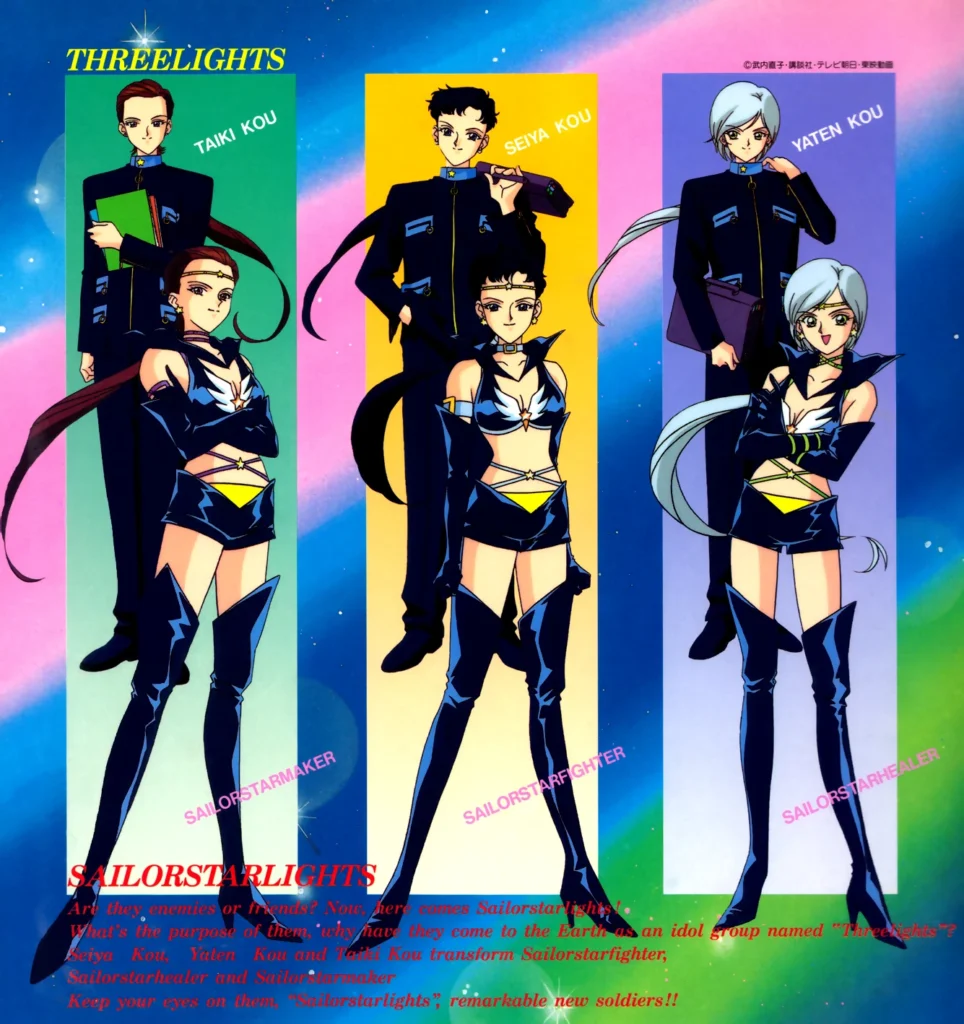
The Sailor Starlights in both their male and female forms.
You see, this isn’t about what money should dictate. It is about what rightness should dictate. I want to see a gay man saving New York City from the latest mad-mind criminal or alien invasion because I have a right to. Just like a straight man gets to have Batman, or a Black man gets to have Black Panther, or our female-identifying friends get to have Wonder Woman or Storm. (Can we please make her movie next? And do it justice!)
And that is really what this is about—seeing yourself. Not only portrayed as an average civilian, but as the protagonist. A superhero. Yes, even a deity. We all need to be told—and then reminded—we are magical. All of us. Regardless of gender or skin tone or who we grow to love. We need to be taught that we are not just the ones who need to be saved—even though that is the only story we’ve been told—but that we are the heroes, too. We are deserving of super-human strength, weather control, and casting levitation spells. We are deserving of more than just sitting on the sidelines, or absent from the game altogether.
Trust me when I say that, even on the most basic level, seeing yourself in film or literature or a comic book can be exonerating. It liberates you from the idea that you are a victim, deviant, or anomaly. It says not only do you exist and kick ass, but you belong. And while we still may never be able to wrap a towel around our necks and suddenly learn to fly, there is one thing—one super power—that can serve us in this world: validation. Knowing not only that we deserve to be here, but that we are welcome, too.